2009 වර්ෂයේදී ආරම්භ කල ශ්‍රී ලාංකීය වේදිකාව නම් මෙම වෙබ් අඩවිය, ලාංකීය කලා කෙත පෝෂණය කිරීමට ගත් කුඩා වෑයමකි. විශේෂයෙන්ම අන්තර්ජාලය තුල වේදිකා නාට්‍ය ගැන පලවූ ලිපි එකම වෙබ් අඩවියකට යොමුකොට, වේදිකා නාට්‍ය හදාරන සහ ඒ පිලිබදව උනන්දුවක් දක්වන සැමට පිටුවහලක් වන ලෙසට එය පවත්වාගෙන යනු ලැබීය.

2012 වර්ෂයේ සැප්තම්බර් මාසයේ www.srilankantheatre.net
නමින් අලුත් වෙබ් අඩවියක් ලෙස ස්ථාපනය කල මෙම වෙබ් අඩවිය, ලාංකීය කලා කෙත නව ආකාරයකින් හෙට දවසෙත් පෝෂණයේ කිරීමට සැදී පැහැදී සිටී. මෙම නව වෙබ් අඩවිය තුලින් වේදිකා නාට්‍ය පමණක් නොව, චිත්‍රපට, සංගීතය, ඡායරෑපකරණය, සාහිත්‍ය සහ තවත් නොයෙක් ලාංකීය කලා මාධ්‍යන් ගැන විශ්ලේෂනාත්මක ලිපි ඉදිරිපත්කිරීමට බලාපොරොත්තු වෙමු. ඒ සදහා ඔබගේ නොමසුරු සහයෝගය සහ දායකත්වය අප බලාපොරොත්තු වෙමු.

Tuesday, 12 January 2010

'Makkal Kalari' (Jana Karaliya) - a theatre bridge between Sinhala and Tamil people

Author: Anjana Gamage

Source: Daily News

DRAMA: "We will not directly speak on peace. But the entire audience who view our dramas will realise that it as a collective work by both Sinhala and Tamil theatre loving groups.

For example, Tamil artistes would play roles in Sinhala dramas and Sinhala artistes would perform in Tamil dramas.

The presentation of our theatre production, would provide some kind of a signal to the inner thoughts of the viewers in an exemplary manner", points out veteran small screen and stage drama director Parakrama Niriella.


Parakrama Niriella

"Jana Karaliya" or " Makkal Kalari" in Tamil means theatre of the people. "Jana Karaliya", a drama and theatre activities group, which focuses their programmes throughout the country, was a brain concept by Niriella two years ago.

Speaking on the object of "Jana Karaliya", Niriella said: "Jana Karaliya" was launched in July 2004, just two years ago. But I had immense experience in handling theatre production with Haththotuwagama in 1970s when we were doing the production of "Sitha and Rama".

However I had a difficulty with the term of 'performing space' in stage dramas. We were used to call the stage in Sinhalese as "Ranga Madala" or "Karaliya" or " Vedikawa".

But in Europe, although they called it "Stage" when it comes to use, it means a lot. The stage dramas should go to the ordinary people. We should offer it in more attractive way rather than it was".

Describing the activities of the mobile theatre group of "Jana Karaliya", Niriella said that the unique of its mobile group is that it owned a huge tent that can accommodate thousands of theatre lovers at once.

"It is called new arena type theatre. The mobile theatre group in Colombo visit the area they chose and put up the tent there. From that point they start their theatre activities. The very first mobile theatre came to live from Anuradhapura.

Another one was held in Trincomalee. The mobile theatre is different from the applied theatre. We have a group consisting of Sinhala and Tamil youth of 25 members. The dramas produced by these members will be shown from time to time at the tent.

Apart from the performance, we will also hold drama workshop for youth and series of workshop and practical sessions for Sinhala and Tamil teachers in the area with the intention of promoting their knowledge on theatre which will assist them in teaching Drama and Theatre in schools".


The huge tent

This time "Jana Karaliya" has launched its Drama and Theatre programme in Puttalam District. "Jana Karaliya" Mobile Theatre Group arrived Puttalam in May and installed the Mobile Theatre at St. Mary's Tamil Maha Vidyalaya ground.

They will stay there till mid of July, engaging with Drama and Theatre activities. They have already started conducting Drama and Theatre appreciation programmes at Puttalam, Mahakumbukkadawala, Karuwalagaswewa, Anamaduwa, Vanathavilluwa, Serakkusiya, Kalpitiya and Nawagaththegama with the assistance of the Provincial Secretaries of those areas.

They will start Drama and Theatre appreciation programmes and workshops for school students and teachers after A/L examinations and holidays.

"Jana Karaliya Drama Festival", the most attractive item of their activity in the Jana Karaliya Mobile theatre started from June 23 and continue till July 3.


Mobile theatre activists

Jana Karaliya Sinhala and Tamil Drama production, "Charandas", "Seethambarapata", "Andaramal", "Devlowagamana", "Charandas Kallan", "Mayappattadai", "Erukkalam Poo", "Dewaloha Payanam" and Children's Plays of Saman Pushpakumara ("Ahankara Kiribabi and "Dangayo Ne") and Sumith Samarasinghe ("Soru Evilla") also included in the list of Drama Festival scheduled.

All the "Jana Karaliya" plays are collective efforts of the Janakaraliya Mobile theatre group that consists of Sinhala & Tamil youth.

Palitha Abeylal, Jayantha Kumara Muthuthanthri, Suneth Shanthapriya, Sokkalingam Krishanthan, Chaminda Prasad, Manjula Ranasinghe, Nishantha Kularatna, Sumudu Mallawarachchi, Thyagaraja Sivanesan, Muniyandi Kalidas, Verni Theresa, Ajanthan Shanthakumar, Arosha Tharanganee, Sineth Devinda, Dinesh Swarna Sri Livera, Sam Paul, Malithi Kumari, Praneeth Jeewantha, Chinthaka Kodithuwakku, Rasaiya Lohanadan, Selvaraj Leelawathi, J. Sr Devi and B. Radhika are performing artistes in all these plays.

H.A. Perera has composed music with the assistance of Sumudu Mallawarachchi and Tharindu Gamage. Palitha Abeylal is the sound controller, Ajanthan Shanthikumar is the lighting technician and Chaminda Prasad is the Make up Artist. Ravinda Mapitigama assists in choreographing and direction.

Dilip Rohana is doing the management while Parakrama Niriella and H.A. Perera leads the entire Jana Karaliya Programme.


"Aswenna" "We of the Eighties" (Asuve Api)

"We of the Eighties" (Asuve Api), uniting participants of theatre workshops held in the eighties decade at the Soviet-Sri Lanka Friendship League, will honour their four "gurus" at 6 pm on November 28, at the Elphinstone Theatre in Colombo, in a ceremony named "Aswenna".

Veteran make-up artiste and actor Vasantha Vittachchi, award-winning film, stage play and television director Parakrama Niriella, theatre music director and actor H.A. Perera and Tower Hall Theatre Foundation Director-General and lawyer Douglas Siriwardena will be presented with "Aduru Harasara" awards on this occasion. Proceedings will be led by cinema and stage personalities Sumithra Peries, Irangani Serasinghe, Somalatha Subasinghe and Prof. Sunil Ariyaratne, interspersed with concert items of songs and excerpts from stage plays. The special oration of the "gurus" will be delivered by theatre personality Jayalath Manoratne.


Vasantha Vittachchi


Douglas Siriwardena

"The demise of respected people, heard over TV and radio, tormented us that we were not treating our teachers well, the result of which was Aswenna, 25 years after the workshops, " said stage actress Mali Jayaweerage, Treasurer, Asuwe Api. Asuve Api souvenir will be a collection of informative writing on the local history of theatre workshops, street theatre and pioneers of the past years. Articles contributed by Jayantha Chandrasiri, Kumara Siriwardhana and other veterans in the arena, will make it ideal for school libraries, said Jayaweerage.

Workshops

The workshops, held free of charge from 1984 to 1988, were the launching pad for tele-drama, stage play and film directors and actors, radio announcers, journalists, script-writers, make-up artistes, doctors, engineers, lawyers and even politicians, numbering nearly 200 and now recognised for their individual ability. Dr. Sena Nanayakkara, Jayalal Rohana, Jayantha Chandrasiri, Jayalath Manoratna, Ashoka Handagama, Anoma Jinadari, Sudath Mahadivulwewa, Malcolm Machado, Udeni Alwis, Mali Jayaweerage, Manohari Hewawasam, Channa Perera, Ajith Lokuge, Nilmini Buwaneka and Central Provincial Council Chairman Saliya Bandara Dissanayake are among them. "Of these, over 40 people work full-time in the theatre field," said tele-drama and stage actor Ajith Lokuge.

Douglas Siriwardena, the initiator of the workshops, blossomed as a playwright with "Ambu Semiyo" while working in Thulhiriya Textile Mills. Earnings from theatre productions paid his way through Law College. "Suba Sendevak" and "Hitler" were his other plays in the seventies. Involved in the National Youth Council theatre workshops conducted all over the island, he graduated to the Soviet-Sri Lanka Friendship League workshops, assisted by Parakrama Niriella, H.A. Perera and Vasantha Vittachchi as Instructors. Political violence in the later years called a halt to the workshops.


H.A. Perera


Parakrama Niriella

Parakrama Niriella is credited for his contributions to the open-air theatre in Sri Lanka. Through his Open Art Circle, he scripted and directed the award-winning stage play "Sekkuwa" for which Perera directed music. After producing stage plays "Galileo" and "Uttamavi", he joined National Rupavahini and scripted and directed the tele-drama "La Hiru Dahasak". Later, he became an independent artiste and directed the award-winning film "Siri Medura." Niriella is the founder of "Jana Karaliya" folk theatre troupe which produced the play "Charandas" in both Sinhala and Tamil.

Stage plays

H.A. Perera, asked by a friend to join Ranga Shilpa Shalika conducted by Dhamma Jagoda at Lionel Wendt, came in the hope of studying music but found his vocation changed to acting. He acted in the stage plays "Raja Dekma", "Bosath Dekma", the banned "Wedikkarayo", "Spartacus", "Julius Caesar" and as Jesus in Niriella's first film direction "Palamuveniya saha Anthimaya", Sumithra Peries' "Sagara Jalaya Madi Henduwa Oba Sanda" and left an indelible mark as an actor in the film "Keli Madala". He directed music in Niriella's stage plays and was the first instructor of Jana Karaliya. On stage, he won the awards for Best Actor and Best Music Direction. On cinema, He won the award for Best Supporting Actor. Though Perera has not acquired a university degree, he is said to possess a vast knowledge and practical experience in the theatre field.

Vasantha Vittachchi is the first local make-up artiste to win awards in all three fields of theatre, cinema and television. He joined Niriella's Open Art Circle in the seventies, studied under Dr. Solomon Fonseka and acted in street theatre. He was the make-up artiste Ranjith Wickramasinghe's assistant in Chandran Ratnam's film "Aadara Kathawa" and continued being a make-up assistant in the films "Viragaya" and "Kristu Charitaya". His first award in make-up was for the stage play "Abuddassa Kolama" and the first film award was for Boodie"s "Sihina Deshaya." (Profiles provided by Manohari Hewawasam, Secretary, Asuve Api.)

‘The demise of respected people, heard over TV and radio, tormented us that we were not treating our teachers well, the result of which was Aswenna, 25 years after the workshops, “ said stage actress Mali Jayaweerage, Treasurer, Asuwe Api. Asuve Api souvenir will be a collection of informative writing on the local history of theatre workshops, street theatre and pioneers of the past years. Articles contributed by Jayantha Chandrasiri, Kumara Siriwardhana and other veterans in the arena, will make it ideal for school libraries, said Jayaweerage’

One man, 14 Personalities


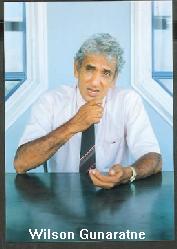
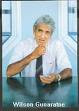
Wilson Gunaratne on portraying diverse personas:

Seasoned actor Wilson Gunaratne of Charitha Hathak fame is all set to embark on yet another great adventure in his career by portraying 14 diverse characters on screen. Named 'Neighbour in Trouble' this unique television series will begin work shooting in locations in Colombo and around the island soon.


Wilson Gunaratne in ‘Neighbour in Trouble’

It was mainly the success of Charitha Hathak which triggered the idea for 'Wilson at the 80'. The thought took shape while the actor turned director was at Sandeep Marwah Studio, Delhi, engaging in research.

"I was inspired by what I found. I worked hard to build up 14 characters, each very different from the other, to present them to the art scene. This is the first time that an actor had attempted presenting such a large number of characters in one series in Sri Lanka," he explained adding that the fourteenth character will be unveiled at a special event organized by the 80 Club of Colombo. Titled 'Wilson at the 80' the event will take place at the 80 Club House on September 26 at 7.30 p.m. The evening will also see Gunaratne taking to the stage with music garnished with old hits and a considerable dose of comedy.

"'Neighbour in Trouble' is a humorous comedy based on cultural conflict and language barriers. You can expect English and Sinhala dialogues in the series. This consists of 12 different stories. The story rotates around a team trying to run different types of projects and organizations. None of the different settings are spared and you may find traits of people whom you have met and worked with in these characters," he explained.

According to Gunawardena some of the latest technological devices will come to play in shooting the episodes where two or more roles portrayed by him are present in the same scene.

He says, "At times the viewers will able to see me portraying all 14 characters in one frame. Nobody had tried it out before in any of the local productions. It is a time consuming and expensive task but I decided that as I might not get a chance to put the idea into practice in around five years, I might as well take the plunge. I felt that I am still up to it to take on this challenging task and do justice to the project," he smiled.

He says that it is through practice and hard work that an actor is able to shift into roles quite different from each other in a matter of minutes. Continuous rehearsals help to prefect the loose ends and help him essay his role up to his satisfaction.


The many faces of Gunaratne

"I was invited by the studio to shoot the production in India but I preferred to engage in the process on local soil to enhance the dignity of our Motherland," he stressed adding that each individual has a responsibility towards upholding the value of the country.

An expert at imitating voices to suite the diverse roles, Gunaratne said that he had already recorded and decided on 14 different voices for the roles he hopes to bring to life. Two Indian actors will be joining Gunaratne on the sets but the rest are local artistes.

"I also aim to star in 28 different roles for a film. I have already composed 28 different voices for the project and hope to begin work on it next year," he revealed. Gunaratne and G. Chandrathilak are working on the script.

"The film will be based on the concept of totally rejecting terrorism and I believe that the time has come for us to start finding the answers to the problem which had been a canker in society for nearly three decades. It is up to a Government body and other authorities to take note and support this mission."

Speaking on his ability to portray diverse roles Gunaratne set Indian actors Sivaji Ganesan portrayed nine roles in Navarathri and Kamal Haasan playing 10 roles Dasahavatharam as examples.

"There are opportunities for actors to portray many roles in foreign projects but here the maximum number of characters offered to an actor is two. I got the opportunity to not only impersonate a number of different characters but also act with the same characters in same frame," he noted.

On his successful stage play Charitha Hathak he notes, "The play ran for over nine years continuously even while the country was affected by terrorism. The script was always updated with current issues being included to cater to the needs of the public. People are still vying to see the play. It was first staged on July 7, 2000, at 7.07 p.m. I play seven different characters, as the title suggests, in the play. We need to train youngsters to play characters which are completely different from each other. If the authorities presents me with such an opportunity, I am willing to take up the task," he concluded. You can contact him on 0722251865.

'Charitha Hathak': Comedy with a lesson


Author: Sanath Weerasuirya
Source: Sundat Times Mirroe Magazine

'Charitha Hathak', a popular stage creation by Wilson Gunaratne will be staged at Elphinstone theatre on March 18 at 3.30 and 6.30 pm.

Described as the "Comedy of the Millennium" (Two Two Hours with Ko Ko Kodi), "Charitha Hathak" is directed by Wilson Gunaratne, while the scriptwriter is Chandratilak Gunaratne and co-producer is Ramani Fonseka.

Wilson Gunaratne'In western countries the actors are given a chance to play more than a single character. But in Sri Lanka it is not a common practice. Once Shivaji Ganeshan acted nine characters in 'Nawa Raathri'. That was a film and nobody has done anything more than double acting in local films', Wilson said.

I was always looking for a chance to create this type of drama. I'm having 65 different voices in my voice bank. It is just not luck but hard training, studying and practice,' have gone into it he explained.Wilson was a hotelier now turned actor.

"I am a professional actor now. I'm really happy because I have a vision. I have a message for the society in 'Charitha Hathak.'

You must give suitable positions to suitable people in the society. But unfortunately we do the reverse. Most of the top places go to unqualified personnel,' he explained.

'It is time to correct ourselves. That is what I'm trying to say in this drama. The message is given with humour,' he added.

'Charitha Hathak' has completed 37 shows within eight months, since its opening.

This is a unique presentation and certainly would be the newest experience for the drama lovers in Sri Lanka. This is the only stage play in Sri Lanka at present in which one actor portrays seven characters on the stage.

Kodituwakku from "Nonava-runi Mahatvaruni" Pappa, Prof. Pragnaratne, Transport Teacher Mr. Bastian, Prof. Marenzie (Italian) are among the seven characters. Also the cast includes Ramani Fonseka, Susil Perera, Premaratne Tennakoon. The versatile actor Wilson Gunaratne is using seven different voices with the appropriate costumes and make-up brilliantly to portray the above seven characters.

The story rotates around an aircraft which has been grounded on the runway. The pilot and administrator are unsuccessful in their efforts to get it airborne.

The uneasy passengers are looking forward to a smooth and trouble-free journey as they have been promised by 'Dreamland' Airways.

The pilot and crew members are unable to fulfil the passengers' expectations.

The pilot and the administrator do not give up their efforts in getting the aircraft airborne.

In this process, the ultimate result becomes not only a tragedy but also a comedy.

Art and Theatre of Tamils

Source: Jaffana ( Yarl - Paanam)


Even though in such fields as architecture, sculpture, painting, music and dance, the Tamils of the Peninsula (indeed, the Tamils of Sri Lanka) followed the trends and patterns prevalent in South India, there is one area in which they put their stamp of originality and indiganity: Naddu Koothu or Folk Play. It consists of dancing, acting and musical dialogue inextricably interwoven. Being a "vital element in the community life of the Tamil people," I it reflected in many ways the customs and manners of the people as well as the distinct phases of their social and institutional life. Though it was in a "moribund condition primarily because it has been denied the social status it once enjoyed, by the sophisticated society" 2 Of colonial times, much has been done in recent years to present it as the national heritage of the Tamils of Sri Lanka.

There were various types of Koothu: Vasanthan Koothu, Paraimela Koorhu, Kaman Koothu, Kathan Konthu, Vaciamodi Koothu, Thenmodi Koothu. Among these, the first two consist of singing and dancing without much of a well-knit story; in addition, they were merely repeated in the same form as they were written originally without any change or adaptation Kanurn Koothu focuses on the mythical story of Siva burning Kaman, the god of love, and Kathan Koothu narrates the puranic story of the hero Kathavarayan, a creature of Siva's consort, Parvati. According to Vithiyananthan, who was greatly responsible for making Koothu "modem" and "respectable", "episodes from North Indian Literature are enacted" in Vadamodi or Northern type and "South Indian and indigenous themes" are generally to be found in Thenmodi or Southern types; besides, these two types also have different music, dress and dance forms."

Further, Thenmodi is claimed to be more ancient than Vadamodi which is "akin to the modern dance".

Sillaiyur Selvarajan, a knowledgeable artist and poet, characterizes Thenmodi and Vadamodi in the following manner:

  • Vadamodi
  • Theme: Hindu epics and puranas
  • Stress: Heroism or bravery
  • More: Dancing
  • Less: Musical Singing
  • (New: North Indian Melodies introduced)
  • Thenmodi
  • Theme: Christian stories
  • Stress: Love
  • More: Musical Singing
  • Less: Dancing

Selvarajan admits that before the advent of Catholicism, Thenmodi depicted Hindu themes, but those scripts are not available today. According to him, in Thenmodi there exist rich variations in singing from region to region, and from the manner in which melodies are sung, one can know the character of the people of a region.

It is important to note that Roman Catholics, who are credited with having preserved and fostered Thenmodi Koothu, made use of this form of art to propagate their religion during the time of the Portuguese and later to safeguard it under the Dutch. Rev. Philippus Baldeus, the Dufch Calvinist Minister, mentions that most churches of Roman Catholics had "scaffolds or theatres" near them where events from the Bible were enacted on holydays.

It is quite possible that the Catholic missionaries who came from Goa and from South India influenced to a great extent the Catholic tradition of Naddu Koothu and hence even the term Thenmodi might be a pointer to the South Indian connection.

Naddu Koothu, which according to many is derived from the

South Indin Therukkuthu, literally Street Play, of South India, was performed originally in the open air and usually on a circular platform, which was raised from the ground with earth or sand. There were no seats, no props and no change of scenes. Oil-torches were the only lighting devices. Actors moved in a circle or moved round about half the circumference in order to make themselves visible to the audience seated round the raised platform and to make themselves heard by it. Instead of the curtains, a piece of cloth was used behind which actors could stand before they were introduced to the audience by the regisseur of the play called annavi.

The staging of Koothu had its social or group dimension and dynamics. It was the collective "ritual" and festival of the entire village where it was held. Relatives of actors, singers and musicians and other people from neighbouring villages were invited to, and were present at, the performance.

There were some usual cernmoies (in many villages) that were connected with the production and performance of a Koothu. The ceremony of casting (for the play) was called saddankoduthal. Those who wanted to take part had to undergo an audition test. Certain roles were reserved for certain families for various reasons. Participants chosen for a role (or roles) were handed their parts written on olas or palmyrah leaves (nowadays on paper) by a person of eminence and respect.

After this initial ceremony, rehearsals went on almost every night for four or five months.

Next followed a ceremony called sathankai, which lasted from morning till late in the evening to which people from neighbouring villages were invited. This ceremony consisted in the wearing of anklets by the actors. This was followed by Kizhamaikkoothu in which actors, wearing the anklets, performed during the day.

Nearly a week before the final performance, the entire play was staged without costumes. This event was called velluduppu.

The day of performance had an air of festival. Crackers were fired and hospitality was extended to all the relatives and friends who had come to see the play from other villages. During the performance, friends and relatives garlanded the actors, pinned notes of cash on their costumes or donated ornaments of gold. After the performance, the entire cast and some spectators went to the temple to dance and sing.

Catholics went to the nearby church to sing a concluding benediction called mankalam.

Often, actors went in a group to houses of their relatives and families of prominence to receive due honour and gifts.

It was also usual for unmarried young men to get married after taking part in such a performance.

In conclusion, the following observations may be made regarding Koothu:

Firstly, the Naddu Koothu of the Tamils of Sri Lanka have preserved the fundamental conception of drama as a dance, namely the representation of a series of actions "through rhythmic motion". Indeed, the expression for dramatic performance in Tamil - nadagam adinan or koothu adinan -, which means he danced the play, aptly connotes the essence of theatre as traditionally understood by Tamils.

Secondly, Naddu Koothu has many elements of symbolic theatre. Many actions and settings may be and are mimed. "Consequently dramatists need not always look to the West for inspiration about pure or total theatre.

Thirdly, though most of the themes and stories of Naddu Koothu were and still are religious and moral in character, reflecting perhaps the didactical nature of Koothu, one need not do away with or even minimise the perennial value of such general and universal themes in favour of touching the "needs of the present society". This means that themes affecting the present should be developed without abandons the age old ones"

Fourthly, though Naddu Koothu was usually associated with people from lower strata of society earlier and "has necessarily been practiced in isolation", a new awareness has dawned in the last few years that it is neither Bharata Natyam nor Kathakali but Naddu Koothu which is the cultural heritage of the Tamils of Sri Lanka.

Sri Lanka's unusual folk theatre


Author: Ethirajan Anbarasan
Source: BBC News, Hatton, Sri Lanka

kamankoothu peformer
A young kamankoothu performer
It is an unusual folk theatre where actors as well as spectators perform together.

The subject deals with the life and death of Lord Kama, Hindu god of love and passion.

The whole village participates in the long-running theatre - a play can go on for 11 or 30 days - that eventually becomes a kind of festival.

At a time when many folk traditions are struggling for survival, kamankoothu, a centuries-old folk theatre is still being performed among Tamils of Indian origin in central Sri Lanka.

The Indian Tamils, mostly tea and rubber plantation workers, believe that they will become prosperous if they celebrate the festival of Lord Kama every spring.

While professionals take centre stage, villagers also take part, usually as a result of vows and prayers they have made at critical moments in their lives, such as before the birth of a child, or when they are hoping for a good harvest.

"Villagers sometimes make vows when they are in distress. Once their prayers are answered they will participate in the kaman theatre," says Anthony Raja, a Kandy-based researcher on folk traditions.

Hard life

A hard life faced thousands of labourers brought from southern India to work on the plantations by the British in the early 19th century.

Even my sons are not interested in this folk theatre. I am afraid it may die with me
Pichaiah, director-composer
Social and geographical divides on the island prevented them from mixing with either the majority Sinhala or the Sri Lankan Tamil population.

Their only solace came from folk traditions which helped them to escape from their miserable lives in an alien environment.

Unlike many other folk forms, kamankoothu is a religious tradition as well as a form of entertainment.

The performance is tinged with sadness.

It has its roots in a legend in which Hindu god Shiva the destroyer reduced Kama to ashes when the latter apparently disturbed his prayers.

When Kama's grief stricken wife prayed to Shiva to return her husband, he agreed to restore Kama, but only as an invisible man.

During the festival, villagers split in groups while fiercely debating whether Shiva did indeed reduce Kama to ashes.

On the sidelines, street theatre performances showcase various legends from Hindu mythology.

Villagers play the roles of Hindu gods or demons.

Interestingly, the play moves beyond the stage.

Rituals and celebrations happen in different parts of the village.

The performance stretches over many days with plots, sub-plots and sometimes a play-within-a play. The songs, music and dance all contribute to the drama.

Tea garden workers form the major audience

"People will dismiss you in no time if your verses and narration do not impress them. We constantly try to add novelty in our performances," says Pichaiah, a kamankoothu director-composer from the central town of Hatton.

Unlike many other composers, Mr Pichaiah cannot read and write. But he learnt hundreds of songs from his teachers and now makes a living by performing folk arts among plantation workers.

Pichaiah regrets that kamankoothu does not interest the youngsters, who are more hooked on movies and soaps.

"Even my sons are not interested in this folk theatre. I am afraid it may die with me," he says.

Monday, 11 January 2010

Dr Henry Jayasena: a humble tribute


Author:

I met him three years ago, in the make up room of a recording studio. Of course I had seen him on TV, on the screen, on stage; he was a legend. But here I was, slightly sleep deprived and nervous, trying to pin together the fall of my purple silk saree and trying to convince the make up guy that he was putting on too much lipstick on me. A familiar voice and his reflection in the mirror, a humble “hello, I am Henry”. Yeah, right. Like I didn’t know. I stuttered something to the effect of ‘of course I know who you are, I cant believe I am meeting you for real’. A gentle smile. A switch to mother tongue. “Ithin daruwa, mokadda magen ahanna yanney” I had a set of questions prepared. Written in English, translated into Sinhalese, mulled over. I had spent a sleepless night over them, wondering how you begin to ask someone about how they faced cancer and the death of a beloved spouse all in one go. I said "I have a few questions prepared, it’s mostly about how you coped with your illness, sir." The video we were recording was for an organization called Mithuruwela, a non-profit organisation set up to counsel cancer patients and their families, to create awareness about cancer, and to dispel myths about the illness. Dr Jayasena was a popular and well loved public figure, his words would matter, would make a difference. So here we were.

During the interview, before, and after, I learnt about strength and courage from this man who was famous for his dramatic and literary skills. When the video was aired I realised that tears filled his eyes once during the interview, and filled mine many times. Listening to him, I forgot that there were bright lights and cameras around us, so drawn was I to his experience and the eloquence of his telling it. He shared every incident, from the shock and denial to the long painful hours of chemotherapy to the arguments with his wife about eating, from the conversations with his doctor to how he coped with his treatment, and gradual recovery. In his words there was an incredible sincerity, and he spoke not only to all out there who have the illness already but to those who might yet fall victim to it. His voice broke for a moment when he related how his wife saw him through the illness but passed away suddenly, but he recovered quickly, no self-pity thwarted his fine sense of humour and his desire to reach out to fellow cancer patients. When he felt I was stumbling a bit, uncomfortable with the nuances of formal spoken Sinhala, ever sensitive, he switched to English. There was only one recording, and that was it.

I didn’t realise that exactly three years later he would be gone. I didn’t spend much time with him, it was only two hours perhaps. I walked with him to his vehicle and for some reason felt all choked up. He joked about incontinence. In some way he reminded me of my own father, long gone. It was good to meet you, he told me. Meeting you was a life-changing moment, sir, I said. I know, it sounds tacky, but I meant it. If / when I get cancer I will remember that sunny day in November when I met Dr Henry Jayasena. I watched the DVD of our interview again yesterday, and realised that he will keep inspiring people long after his death. “We may meet again, child", he said, in Sinhalese. I wish we had. May your Journey in Sansara be peaceful, and thank you for the courage we may all need in the future.