Source: Virtual Library Sri Lanka
In Sri Lanka, the traditional and the modern, the old and the new in theatre can be seen in striking conjunction. Based in Colombo, the capital city, there is a burgeoning, cosmopolitan, modern theatre, which presents original works and translations (of Beckett, Gogol, Gorky, et.al.) in a wide range of forms and styles. In the rural areas, age-old ritualistic theatres are performed to promote the welfare of the community and to heal the sick. In between are various folk theatres – the  entertainments springing from a predominantly agricultural way of life. And, as in all modernizing societies, many of the older forms are waning away while the new theatre is flowering.
The ritual theatres
The ritual theatres of Sri Lanka are among the oldest extant performances with an unbroken history. Legend traces their beginnings to pre-Buddhist times. However remote their origins, it is quite clear that the ritual theatres, like all living art forms, have been changing over the years, discarding some elements and absorbing others. As practiced today, ritual theatres, are generally nightlong performances addressed to the numerous deities and demons of the folk religion.
A vast pantheon of gods and demons inhabits the still vital world of Sinhala folk belief. Depending on time and circumstances, and their particular spheres of influence, these powerful beings can impinge in various ways on the affairs of men. For example, gods can assure a plentiful harvest and bring succor to people in times to people in times of distress. The demons, on the other hand, are evil in their effects: they possess people, making them ill.
The primary purpose of the ritual theatres is to propitiate the gods and the demons, so that they will confer their blessings or heal the afflicted. Where the demons are concerned, there is an exorcist aim also. A basic assumption in these theatres is that these beings have the right to expect certain oblations and offerings from humans. If these are not made, the gods will either cause harm to people or desist from helping them as for the demons. However, once an offering is made in the proper manner, the demons are obliged to remove their malefic influence and return the patient to good health.
The ritual theatres are more than modes of oblation: they are also re-enactments of the original ceremonials in which the covenant between the otherworldly forces and the human forces was first ratified or demonstrated. Typically, the good are invited to watch the proceedings; the demons are summoned in order that they may be persuaded to behave in the manner they did on a similar occasion in the distant past.
Although there is great dramatic potential in this view of the relationships between the human world and the spirit world, the ritual performances have not evolved into continuous, full-scale dramas. The general conception is theatrical (the space used is constantly referred to as the “Ranga Mandala” -arena of performance) but the form itself is highly segmented, mixing long sections of verse narrative, incantation, chant, and dance with dramatized episodes, which employ dialogue and mime as well. The episodes are culled mainly from stories dealing with the genesis and the background of each principal deity or demon. While almost every performance element is brought in, it is dance that predominates in most ritual theatres.
Furthermore, these theatres have an unmistakably composite character; in the course of time, a number of different but allied rites have come together. This suggested both by the strong reminiscences of archaic year rites and animistic cults found in them, and by the diversity of gods and demons coming within the ambit of each ceremonial.
While they all occupy one broad framework on account of the similarity of their essential attitudes and structures, the ritual theatres can be conveniently separated into several categories. In the large-scale performance, the collective aspect predominates – they are done for the welfare of a whole community, the village being the primary unit. These are generally addressed to gods and are given annually (customarily at harvest time) or when the community is threatened by epidemics of certain infectious diseases thought to have links with the spirit world. In the latter case, a vow is first made that performance would be given upon speedy release from the grip of the epidemic.
There is a second category of ritual where the beneficiary is an individual, rather than the community as a whole. Demonic possession is one obvious occasion, which calls for such theatre. Another is evil planetary influence. These theatres, smaller in scale than the communal types, are of course performed when indicated, or rather prescribed by the ritual specialist or astrologer.
Of the major communal theatres, the most famous and undoubtedly the most majestic is the Kohomba Kankariya. Nowadays confined to the environs of Kandy, the Kohomba Kankariya. Nowadays confined to the environs of Kahomba Kankariya traces its beginnings all the way back to the first Sinhala kings. The name means the rite of God Kohomba, an animistic deity, which is suggestive if the antiquity of the ritual. However, the original cult appears to have coalesced with several other, perhaps more recent, folk ceremonials. Today it clearly displays this mixed ancestry, a feature common to all Sinhala ritual theatres.
In keeping with the usual pattern, the Kohomba Kankariya is a somewhat disjointed performance separating into a number of named segments or episodes. A common set of ritual objectives and a single from of dance, rather than a coherent dramatic structure, link them together. In the Kohomba kankariya, far more than in other aspects comparable ritual theatres, the dance element takes precedence over all other aspects. In consequence, it becomes the finest and most complete presentation of Sinhala dance: in this instance, the Kandyan form. Which is counted the most beautiful of Sinhala dances.
The massed Kandyan dancers in stately head-gear (ves) going into elaborate ballistic formations to the accompaniment of deep, vibrant drum music makes a splendid spectacle. The sheer pervasiveness and beauty of the dance might lead the uninitiated to the conclusion that the Kohomba Kankariya is nothing but an extensive presentation of dance. Despite the elaboration of the dance the ritual purpose has never been forgotten. For example, the opening of the giant Mahaveli river diversion scheme in January 1976 was marked by the performance of a Kohomba Kankariya on the dam site.
The participants themselves treat it with the utmost seriousness and observe the ritual sanctions. A Kohomba Kankariya, moreover, figures as a significant event in the Kandyan dancer’s artistic life: it lffers him the mist challenging occasion for the display of this talents, for he dances in the company of his peers. And it was customary at one time to the time to perform a Khomba Kankariya on the “graduation” of a Kandyan dancer, that is, when he is first permitted to put on the ves head-gear at the end of his training.
The explicitly dramatic segments of the Kohomba Kankarya – nowadays sometimes omitted in performance – come towards the conclusion. Though only peripherally connected to the core ritual, these are of great interest, not only for their use of performance techniques, but also for the way they reflect the social reality that engendered them. Uru Yakkama (the rite of Hunting the Boar) is a case in point. The event is presented in verse narrative, dialogue (often humorous) and mimetic action.
Before setting forth to shoot the boar, the hunter (played by one of the dancers) consults and astrologer for an auspicious time and the proper procedure to be followed. The hunter encounters other animals, which he mistakes for a boar. Eventually, he comes across the real quarry. At this point, a boar-effigy (made of banana stem) is brought into the arena. Now a discussion ensues as to how the boar should be taken, and it is decided that the vest method would be to use a buffalo as decoy.
Now another dancer turns himself into a buffalo by arching his body and placing ins limbs in a particular manner. This animal, noosed after much effort, is then used to entice the boar, which is shot down with bow and arrow. Subsequently, it is dismembered, and the parts are given away to the villages. In this distribution, the actual social order of everyday life is reversed by means of a simple device: the least desirable portions of the carcass are given to he highest-ranking members of the community, and the best to the lowest. Done to the accompaniment of a sarcastic commentary, this achieves a high degree of social satire and criticism.
The Uru Yakkama is but one episode of a type that is found not only the kohomba Kankariya, but all ritual theatres. This makes it clear that ritual theatres have functions besides those pertaining strictly to the spirit world. They deal with matters of everyday reality; in fact, they frequently exhibit a strong tendency to move in the direction of “profane” entertainment having little to do with ritual purpose. This is not a characteristic unknown to other cult ; in Sri Lanka it has been quite pronounced because ritual was, from the beginning, the major kind of performance among the Sinhala people.
Less stately, less costly, hence more frequently given is a group of communal rituals (Gam Maduwa, Devol Maduva, Puna Maduva) deriving largely from the worship of the goddess Pattini (Sinhala variant of the peerless Kannaki celebrated in the Tamil classic Shilappadikaram). Pattini, whose cult is widely followed, is considered to be a powerful deity especially important with respect to contagious diseases. Her intercession is also sought in times of personal distress. Temples (Kovil/devale) dedicated to her are scattered throughout the country.
Ritual theatres linked with the Pattini cult are in the main annual occurrences. The principal objects of worship – representing the goddess herself – are a pair of ankle bracelets, the item of jewellery that played such a crucial role in her own life. Following the normal practice, the core ritual incorporates a number of subsidiary rites, chiefly through mime, dance, and verse narrative. Of special interest is a sequence called the MareIpaddema (death and resurrection), which intimates the great antiquity of the cults that have come to be affiliated with the Pattini theatres.
Since these theatres are performed in many parts of the country, some variations can be noticed in the styled they employ. Furthermore, two distinct forms of dance – “Kandyan” or “Uda Rata” in the up-country areas, and “Pahata Rata” in the low country – are used. At the present time, one is more likely to witness these theatres in the coastal areas (“Pahata Rata”). As with the Kohomba Kankariya, their performance depends on the support of the community.
The second category of ritual theatres those concerned with individual sickness or misfortune – are known collectively as bali-thovil. Bali means rites dedicated to the planetary deities, and are the least dramatic of the ritual theatres. Thovil, given to propitiate and exorcise demons, are as a class highly dramatic and excitingly theatrical.
Bail is a votive offering where chant and incantation receive far greater emphasis than dance and mime. This feature, together with its direct appeal to planetary deities, can be taken as evidence that Bali is later growth than the communal theatres. Another notable characteristic of Bali is the use of images. Large clay effigies, sometimes as tall as 3 meters, representing the planetary deities are constructed in bas-relief fashion, and mounted in upright position before the commencement of the ceremony. The ritual activities take place in front of these images. When they are over, these carefully molded images. Are destroyed. Mainly on account of the heavy expenditure it involves, Bali is seldom performed today.
From Bail to Thovil is a fair leap, though in common parlance the two are linked. The demon world forms the territory of Thovil. The demons are seen as adversaries ever ready to cause harm to men, not as beings capable of beneficence. Thus, apart from propitiation (which is common to al ritual theatres) exorcism also occurs in Thovil. In many instances, the demons are impersonated by masked dancers. (Hence the term “devil dancing” frequently used to describe Thovil.) It is not uncommon for patients to go into states of trance during the course of a performance: at such times, the patient is said to be possessed by the demon responsible for the ailment. These characteristics, implying direct and unmediated encounters with the demons, sometimes turn Thovil into an enormously exciting theatrical experience.
Thovil is an exceptionally interesting curative and therapeutic performance in which the patient’s syndrome is translated into the shape and from of other-worldly creatures who, though evil and frightening, cannot exercise total dominion over man. They can be brought under control. The performers confront them on behalf of the original ritual to reiterate the sanctions within which they mist operate. Accordingly, the demons are obliged to accept the offerings – tokens of what used to extract before the covenant was established – and depart.
The demons must appear before dawn, because they have to return to their abodes without being seen by the sun. Upon arrival in the arena, each demon executes a few steps to the drum, then opens a dialogue with another performer or drummer, asking why he has been summoned, etc. The reason is given: he must accept the offerings made ready for him and the interlocutor now follows – he wants more than is given. Finally, agreement is reached; the demon accepts offerings, blesses the patient and exits. The dialogue is quite humorous, and often heavily charged with obscenities and scatological references.
The in tensest moment in a Thovil performance is reached when the patient becomes violently possessed, and assumes the persona of the apposite demon. At such times, the “patient demon” is closely questioned, and forced to pledge that he will remove his evil influence and go away. Customarily, the patient joins in the dancing at such times. Recalcitrant, unyielding demons are subjected to various punishments, usually exhausting dance at highly increased tempo. Sometimes, they are made to beat themselves with coconut flowers or fronds.
There are several different kinds of Tovil (e.g. Suniyama, Rata Yakuma, Sanni Yakuma), each distinguished by a particular content and a concern with specific forms of demon affliction. Sanni Yakuma is probably the best known, for it brings in eighteen demons, representing eighteen separate diseases (sanni). The demon is identified by the mask he wears, the gestures and mannerisms that attach to him as well as by the verses that signal his entry. Great theatrical flair can be seen in the execution of the entry – each demon, appropriately masked and costumed, sometimes bearing lighted torches in his hands, rushes into the arena from behind an altar (vidiya) amid shrieks and frenzied drumming. These grotesque and fearsome-looking creatures do not however frighten the parent and the spectators. One reason for this is the ribald, comic gesture and tone that underlie their portrayal. Another is the assumption that demons, however malevolent, can ultimately be controlled.
“Arena” is perhaps too suggestive a word to be employed in the contest of these theatres. A raised platform and fixed seating are totally unknown. The audience sits or stands in a circle round the space. A roofed structure is built for certain performances such as the Kohonba Kankariya and Gam Maduva (maduva = shed or pavilion) but this is never thought of as a playhouse. Whatever the ritual prompting behind it, the offering trays, and also as a means of demarcating the performance space the audience is an accommodated outside it – in the open air. For Thovil, the Maduva is not a prescribed requirement. Quite often, the verandah and compound of the patient’s house are used as the acting space. The area thus obtained may be quire small ; moreover, it is a variable one, since the spectators move about constantly, changing the size of the circle.
The absence of a raised stage and a rigidly demarcated acting area means, among other things, that the relationship between the audience and the performers is an intimate one. It also means that lighting is for illumination only – not foe stage effects. Light and fire do play a very important part in ritual theatres. Fire, as is well known, is a ritual cleansing agent. So is the smoke – created with aromatic resin powders – which the performers inhale and envelope themselves in at certain times. Lighted torches, lamps are regular “props” featured in these theatres. Dancers execute intricate, acrobatic steps while holding or twirling several torches at once, then touch them on chest and arms and “eat” the flames. In major communal theatres, “fire-walking” is one of the mandatory concluding rites. The effect of the light and fire sequences is much reduced these days on account lights. In a dimly lit environment, the lights and the flames make for a beautiful, exciting spectacle.
Ritual theatre is generally speaking a formal and solemn event, Yet it is an air of informality that mostly prevails at performances, for they are important social gatherings and meeting places, for they are important social gatherings and meting places too. The spectators are free to move about as they please, and they usually do, especially at Thovils, where the serving of refreshments is a widely observed custom. There are other reasons for the atmosphere of casualness. Few members of the audience stay awake throughout a dusk to dawn “show”. An occasional snooze is not
Considered Improper. Furthermore, these theatres are not designed to elicit continuous and consistent audience attention. There are segments (especially those given over to chant and incantation), which turn into loungers, even for the performers. At such times, the performers who are free rest or sleep.
A word needs to be said here about the performers. They are true professionals after a fashion – not because their entire livelihood today depends on the art, but because they are trained specialists. The training they receive is chiefly in traditional dance and music, either Uda rata or Pahata rata depending on place of birth, family background and other determining factors. They begin quite early (normally before the age of ten) usually under the tutelage of an elder (father, uncle or other relative) since the teaching, learns both by doing and observing. He will learn drumming as well as dancing, but concentrate on one later in life.
To become a ritual specialist, he does not have to join a cult, be initiated, or have a shamanistic experience. He merely learns the lore of the rituals, the procedures and the “texts”. In fact, the student automatically turns into a ritual specialist too as he completes his training of Sinhala dance is traditionally inseparable from ritual. The dance, whatever the style, is developed as the core of the ritual event. In the Kandyan tradition, for example, the education of the dancer culminated in the performance of the Kohomba Kankariya. Dance was pursued as a discipline and practiced almost exclusively in the ritual context, and even today it forms the principal attraction of these theatres.
The “text” of the ritual theatres, which the performers must know by memory, is of course not pieces of dramatic writing, but chants, mantrams, narrative in verse and other balladic material. Most of this may be called “folk” literature; a small part of it, though, is known only to the specialists. Several segments of each performance have no textual basis and are entirely improvised following conventional techniques. For example, in the conversations with their interlocutors, the demons regularly play with words by mispronouncing and punning. Except for these passages of ad-libbing, which of course are in earthy, colloquial speech, there departs occasions when the language of ritual theatre departs from the metrical, stanzaic forms of folk poetry and from incantatory prose.
Their major characteristics – the propitiatory, exorcist intent, the paramountacy of dance, the highly episodic, segmented structure, the elastic form, the lack of a textual base – will probably raise the question whether the ritual theatre are theatres at all. Indeed, they are frequently seen as primitive performances with only the rudiments of drama – the rudiments being those sections where dramatic situations are presented and developed through mime and dialogue.
It is hardly necessary to point out that such a modernistic, literary perspective is inapplicable to these theatres, which were generated and nurtured by societies entirely different from those germane to modern urban theatre. The traditional theatres articulated the specific kinds of relations that the people had with each other, with the environment and with the “other world”. They mixed the sacral and the secular and overlaid religious ceremonial with profane entertainment. They served their several purposes admirably well and were wholly sufficient in their context. To deny that so patently audience-oriented performances are theater is to give a very limiting definition to the term.
To say all this is not to gloss over the fact that the ritual theatres have now reached a stage where all internal growth has ceased. The times have changed, but not the theatres. The cleavage between them and society is increasing, and the current revival interest in the traditional arts has served only to focus attention on their dance and musical aspects, not to transform or modify their subject matte. That they resist “modernization” is part of their essential nature.
That they are still performed is, however, sufficient evidence that these have not lost all meaning and vitality. Of the several very important theatrical qualities they exemplify, the most considerable and noteworthy perhaps is the communal, collective base that is a pre-condition of their being. They are the richly imaginative and functional artistic expressions of a simple but highly integrated society where all endeavour was collective endeavour. This characteristic is evident even in Bali and Thovil for there individual distress is brought into the public domain through the performance and the viewers vitality in the healing by sharing responsibility for the curative and therapeutic procedures.
The ritual theatres are also total theatres. They bring into play, besides the entire range of expressive modes – gesture, mime, song, chant, dace, etc. – certain traditional crafts as well. Bali, as noted earlier, requires the molding of images out of clay and the painting of figures of demons and deities. This is done in a style very similar, if not identical, to the work seen in the image houses of Buddhist temples. The mask carver’s art, a notable one in the Sinhal tradition, was sustained almost entirely by ritualistic theatre. (There is only one non-ritualistic sinhala theatre – Kolam – that uses wooden masks.)
All ritual theatres make profuse use of offering trays (Thatu, Pideni), altars (Veediya, Aile) and other properties especially constructed for each performance. None of these ritual objects are re-used, since they are destroyed or discarded at the end of the event, Moreover, they are made of impermanent materials: banana stem, coconut fronds (gok), and habarala leaf.
Considering the diverse ways in which they have reflected and articulated the culture, harnessed the performance arts and the decorative crafts, the ritual theatres may be said to constitute the mainstream of the sinhala theatrical tradition. Certainly few other theatrical forms are better known or have found wider acceptance among the people. The performances still vibrate with energies absent in the other theatres and they achieve an elemental power with no investment in dramatic writing and no expenditure of scenery and set.
Sokari
The indigenous Sinhala theatres outlined thus far fall strictly within the matrix of folk religious belief and practice. There are some others that lie outside this matrix. Of these, Sokari, now an exclusively Kandyan performance, is a rare transitional form that has retained some ritual import despite a fully secular content Its connection, interestingly, is with the Pattini cult which, as mentioned earlier, has number of ritual theatres devoted to it.
Sokari is performed as a votive offering to Pattini. Their goddess herself does not appear in the action in an instrumental fashion, but is nevertheless an immanent figure. Sokari has one story (like the ritual theatres) and this concerns a man, Guru Hami, his wife, the eponymous heroine, and their rascally servant Paraya (or Pachamira) who travel to Sri Lanka from India, with the intention of setting down and raising a family. In the course of attempting these things, the trio goes through a series of (largely comical) adventures. At one point, young and seductive, elopes with, or is seduced by (the interpretation varies) the doctor summoned to treat her husband who has been bitten by a snake. Eventually she returns, and has a child by Guru Hami.
How, when and why the enactment of this story came to be linked with the worship of Pattini are matters for speculation? That it has the connotations of a fertility rite is however quite obvious. Its without child for sometime, and prays to Pattini for one. She conceives; the birth of the baby is depicted in the play. Afterward, Sokari picks up a child from the audience and rocks it to sleep. All this, together with the sexual symbolism and the obscenities that punctuate the Sokari is the dramatic elaboration of an archaic fertility rite.
Sokari is among the most theatrically accomplished of the folk performances. Its mimetic content is truly impressive in range and economy of use. The principal stages of the sea journey – the procuring of the timber, the building of the ship, the actual crossing of the ocean – and the other happening in Sri Lnaka are presented though highly inventive physical actions that often match and even outdo the sophisticated experiments of the modern stage.
As done in the village setting, Sikari is a non-stop all night “show” beginning shortly after the evening meal. Its ritual necessities are modest – just one simple altar to house that few offerings to Pattini. The place of performance is any open space: threshing floors are commonly utilized for this purpose, again suggesting the fertility implications. The narrative portions, all in verse, are recited by the players (all males) and are unobtrusive chorus to the accompaniment of a drum.
The characteristic movement of Sokari is a circular one – the players go round the arena in simple rhythmic step while narrating the story. They stop to enact a scene, and having finished it, continue the recitation and the circular motion. The scenes are set pieces, which provide room for improvisation and individual creativity. Of the major characters, only the clownich servant wears a mask. At the end of the performance, which comes as dawn breaks, the players take of their make up in front of the alter, supplicating themselves before Pattini, and begging her forgiveness for any deficiencies and mistakes in the presentation.
At one time it was feared that Sokari was no longer being performed and that the tradition itself was on the verge of extinction. Fortunately, this has proved to be a false alarm. At the present time, there are several active peasant Sokari groups,
It can be surmised that the survival of Sokari is due largely to the Pattini cult, which still has many adherents: the performers consider themselves to be devotees of the goddess; it is quite normal for the players to go into trance states during the performance. Sometimes, several members of the audience also follow suit unlike in Tovil and certain other ritual theatres, these by muscular rigidity. Again, unlike the ritual theatres, Sokari in not caste-bound. Nor does the training take as long, because the dancing is simpler.
The Sokari form is responding in a fashion to the changing tastes of the folk audience. The opening sequence in the performance of one group carries a strong flavor of the Nurti, an early modern form of Sinhala drama. Contemporary Sinhala “pop” tunes are being adopted by another group. These will be regarded by that the essential strengths of Sokari remain.
Koalm
From Sokari it is an easy transition to Kolam, a folk theatre that at one time was very popular, but is infrequently performed nowadays. In comparison with Sokari, Kolam denotes a further stage in the secularization of indigenous theatre, for it has attained the status of a theatrical grnre, yet not without clear hints of an earlier ritualistic function. Being more of an open form than Sokari, Kolam has a repertoire of dramas (albeit a small one ) any of which may be selected for performance.
Kolam, now confined to a few locations in the Southern maritime area, is distinguished by the extensive use of masks. These masks, though akin to those employed in Tovil, tend to be more realistic because many of the characters they represent are of this world. A few masks, such as those of the King and the Queen (stock characters both), are quite intricately sculptured and heavy. Further, kolam masks are full masks, not designed to allow a strong, distinct projection of the voice. Going by these features, some scholars have argued that Kolam began as a masked dace ritual, which later become a sung and spoken drama, but did not discard or modify the masks.
Lending support to this argument is the fact that Kolam preserves certain affinities with the ritual theatres in the conceptualization and presentation of characters. Analogous to the demons of Thovil are the stock characters that are brought before the audience as audience as prelude to the dramas proper. There is wife (a randy old women), the policemen, the watermen, his wife and paramour, the village dignitary as well as certain celestial beings and some animals. According to told texts, there are over fifty such characters.
 Kolam Masks: King MAHA SAMMATA and Queen - |
The large cast of the prelude has no direct bearing on the stories that are dramatized, but they are tenuously connected with the story of the genesis of Kolam. According to this, a certain Queen, being with child, suffered from a “pregnancy craving” for “dances and amusement” Which was ultimately satisfied with a performance of Kolam. As each character ends his piece, the question is asked, by a musician who his appearance. (In Thovil, it will be recalled, it is the demon who puts the question, “Why have I been summoned.”) The reply is: “I /We have come to announce that king and the Queen are on their way here.”
It is evident that gallery of characters has grown over the years, though the dramas themselves have remained in the region of five or six. As in Thovil each character’s entry is preceded by a set of introductory verses, which are chanted by the musicians. The character, masked, then enters and dances round the area singing verses descriptive of his or her special talents and conditon. Sometimes, tow or more players represent the same character type. For example, in one tradition, there are five policemen – four constables and a sergeant. This convention allows for the elaboration of the elaboration of the presentations into dramatic episodes. Thus the four policemen may be discovered by the officer. The most famous of these is the episode of Jasa and Lenchaina (the washerman and his wife) – a short play in itself.
The central situation here is a ménage a trios; Jasa has brought a mistress to live with him. The wife Lencina, herself amorous, laments her fate (for she has been married to Jasa against her will) and complains to the Mudal, the village functionary.The case is tried, but not before a good deal of farcical business has taken place. A wily doctor also figures is these events as happens in the Sikari story. But the comedy here is stronger and sharper in social content, perhaps because the Kolam is more secular is nature.
The large gallery of characters and the comic scenes that are woven around them well qualify the Kolalm to be called the Comedian dell’ Arte of Sri Lanka: the and techniques used are very similar.
In common with other native theatres, the Kolam dispenses with all stage paraphernalia. Any level piece of ground suffices; the audience forms a circle round it during the performance, which as usual starts after invocatory chants and daces, addressed to the deities. These brief rites are dined before the alteration (a small in, as in the Sokari). However, the gods are not instrumental or immanent presences as in the ritual theatres. At the end of the event, which is reached early in the morning, the super naturals are invoked again, so that the players may beg their pardon for errors and imperfections in the performance.
There are three main stories particularly associated with the Kolam : Sandakinduru Katawa (katava = story), Maname Katava and Gama Katava. The first tow are form Buddhist lore, the Sandakinduru being a version of the Manora story, which is a staple of all South East Asian theatres. In the enactment of these dramas masks are not used. It is not easy to say when the masks were discarded, if indeed they were functionally employed in the dramatizations. In any event, as performed today, the Katavas lack a distinctive flavour, and it is quite obvious that the true creativity and power of the Kolam reside in the introductory and presentations. With their exuberant theatricality and pungent satirical thrust, they constitute the soul of the kolam : the enactment of the stories appears a tame afterpiece. Whether this has been the case right through the form is not known.
A nearly extinct folk theatre called the Kavi Nadaygama throws some light on the problem. The kavi Nadagama had a large repertoire than the Kolam, but its most popular pieces were Sandakinduru and Maname. Although it made no use whatever of masks, its theatrical style was basically similar to that of the Kolam. These links and differences have been interpreted to mean that the kavi Nadagama was a matural outcome of the Kolam’s experience with the masks. Instead of dropping the masks, which were found and encumbrance, a new from – the Kavi Nadagama – was created, and the kolam itself took the cue from its offspring and discarded the masks from the dramas proper.
Whether this was the actual scenario or not, the connections between the two forms indicate an ongoing process among all folk theatres. Since they existed in the same culture, were performed for the same audience by nearly the same performers and were not bound by a rigid aesthetic, the folk theatres influenced each other continuously. Each did preserve its separate identify, but assimilated diverse elements form others. This process of interpenetration has continued to the present day – Sokari, as noted earlier, has picked up “ pop” tunes, and the Kolam has culled some material from the modern stage.
Nadagama
The next chapter in the story of the Sinhala theatre is the coming of the Nadamama. This happened not more than two hundred years ago, most scholars agree, though no exact date has been established. But there is little doubt as to its source – the Nadagama has no antecendents among the Sinhala theatres and is unquestionably Dravidan in origin.The first Sinhala Nadagama plays, it is said, were translated from the Tamil.
All available evidence points to Roman Catholicism as the agent of the Nadagama’s diffusion among the Sinhaless, if not its begetter as well. It has been suggested that the forerunner of Sinhala Nadagama was a dramatic form constructed out of several South-Indian folk theatres by Catholic missionaries. In any event, the earliest Sinhala practitioners of the Nadagama were Catholics who employed it to dramatise liturgical subject matter. Before long, however, folk theatre in the Western coastal belt, the area most directly theatrical craft – it brought no such appurtenances as scenery or playhouse – but in its music, story material, and in its conception of theatre as a performance divorced from ritual observance.
Musically, the roots of the Nadagama were in the South-Indian Carnatic tradition, whose idiom differs substantially from that of indigenous Sinhala music. In the ritual theatres, Kolam and Sokari, “song” was actually a sort of chant or recitative embedded in the regular metrical schemes of folk poetry, melodic compass. The Nadagama song had a grater melodic range and offered more scope for dramatic expression.
Furthermore, the Madagama gave a central role to music. It was, in fact, a completely sung drama, the traditional to a fully operatic form to develop within the traditional framework. All other theatres used prose dialogue in varying degrees; here it was reduced to an utterance between songs, intoned in a particular fashion. The Nadamama music thus brought a fresh dimension into Sinhala folk theatre.
So did its subject matter. The Sinhala folk theatre had been tied to specific myths or to a very small number of legends determined by convention and transmitted by tradition. The Nadagama introduced fictional material, and thereby opened up hitherto uncharted territory for the Sinhala theatre. In the beginning, it is true, it dealt with Christian themes, but was never thought of as ritual performance or religious drama * . The form was palpably secular, readily at home in the land of adventure and romance.
In its presentational aspects, the Madagama was not too foreign to the indigenous tradition, Its main innovation in this regard, was the use of a raised, covered stage – a temporary structure of piled earth, semi-circular in shape, sheltered by a thatch of coconut palm leaves. There was no front curtain, no sets, and of course no playhouse. The musicians occupied a part of the stage, so did the Narrator or Presenter, and perhaps one or tow singers to serve as a chorus.
The performance starting around nine and lasting till morning (and continuing nightly for a week in the old days) are commenced with the presentation of stock characters - jester, drummer, herald, and so forth. As with the earlier indigenous theatres, the stock characters had their identifying styles of dance and song. Two members of this prologue, called the Deshanvadi, briefly narrated the story to be enacted. Then, after certain other preliminaries, such as the arrival if the king, the drama would begin.
The dramas were long, rather involved tales peopled by eloquent kings, warriors, aristocratic beauties, all consumed by affairs of state and of love. They were written in a mixed tongue, profusely littered with Tamil and pseudo-leaned words. The authorship of the early cannot be established with any certainty; many are attributed to the legendary Philippu Singho, putative father of the Sinhala Nadagama. Little really is known about this man, but he is believed to have been a blacksmith. This gives a sufficient picture of the social level at which the Nadagama was practiced. It was essentially a folk
The Nadamagm became very popular in the Western and Southern coastal belt, but did not spread to the interior of the country. In this area it turned into a much sought after entertainment, even superseding the older theatres. Yet it never made it to the city as truly urban the folds of the folk tradition without evolving into an urban or literary art, though it had a potential in that direction, was not accidental.
The fate of the Nadagama was determined in significant measure by a cultural factor, which is of the utmost importance in understanding the nature and development of the theatre in Sri Lanka. From the earliest times, the dramatic form appears to have been eschewed – indeed despised - by the Sinhala literati: they devoted their abundant labors to prose and poetry. It is unlikely that Sinhala classical culture was unearthed to show that any Sinhala writer worked in the dramatic form. (The earliest extant Sinhala writings date from the 6th century.)
The neglect of drama as a literary form, whatever its causes, also decided the social base of the art. In Sri Lanka, this meant the confining of the theatre to the rural setting and to folk culture – or to the Little Tradition, as anthropologists would say. In consequence, the theatres were very tardy in developing secular characteristics; the propitiatory and exorcist elements persisted as the very core of their being. Most of them retained a fixed and inviolable content without widening into theatrical genres or forms. To be sure, they did acquire and enlarge upon “Profane”, non-ritualistic aspects, but the forms themselves remained unchanged. The opening out of the Kolam and the Kavi Nadagams was probably due to their contact with the Nadagama.
The age-old disdain of the literati towards the theatre lasted into the twentieth century, long after Sinhala literature itself had moved away from the religious bas. The Nadamama enriched the traditional patterns in several ways, but was unable to attract the interest of the literati. It was only in the mid-Fifties that the Nadagama was “discovered” by the modern practitioner as a promising theatrical resource.
Nurti
A truly urban Sinhala theatre came into being only in the last decades of the nineteenth century. Around that time, there arrived in this country a Parsi theatrical company from Bombay, bringing with it a navel kind of drama quite unlike the performances familiar to local audiences. This Parsi theatre, which soon came to be known as Nurti (=this new drama) in Sinhal, was a singular blend of European and Indian dramatic modes and stagecraft.
In terms of presentation, the Nuri adhered to the Western concept of an organized, scenic proscenium stage employing painted backdrops and wings – and of course an enclosed playhouse. Against the scenic splendour thus achieved were placed gorgeously costumed personages (chiefly of royal or aristocratic lineage) who acted out exotic tales of romance and adventure to lilting Hindustani melodies. Audiences in Colombo found this unusual stage entertainment utterly captivating, as did their counterparts in the major cities of South and South-East Asia (The Parsi companies toured extensively.)
Practically overnight, the Nuti was domesticated. Singhala plays were written on similar material, and staged in the same manner to the very same music. Playhouse was built in Colombo to accommodate the Nuti and its rapidly growing audience. Thus was born the first urban, commercial theatre in Sri Lanka. It flourished in the first tow decades (both male and female) who made a living out of the theatre, a stage-struck audience that nightly crowded the several playhouses in Colombo, and a new profession – that of playwriting.
Like every thriving commercial theatre, the Nurti needed a regular supply of new plays. This demand was met by the new Sinhala playwrights who, thought in the craft, learnt rapidly from the models. Fortunately, they did not limit themselves to the Parsi creations – they also turned to Sanskrit classical drama and to Shakespeare. These were rendered in Sinhala, though not with scrupulous fidelity to the originals. And inevitably, they took up local history and Buddhist lore. Of these playwrights who fed the Nurti, John de Silva (1857-1922) won the greatest popularity and a lasting renown. (The first state built theatre in Colombo is named after him.)
Viewed from the perspective of dramatic craft, the Nurti plays hardly pass mister. They carry the deadweight and the crudities of the initial model that inspired the dramatists. The parsi theatrical was an inelegant hybrid created by grafting the already outmoded European techniques of staging onto a dramatic form which was itself an admixture of Indian classical and folk elements. The Sinhala playwrights retained the prototype’s accent on song, high gesture and spectacle, but did not address themselves to the task of eliminating its defects and improving the form.
It is important to remember, however, that the Nurti writers were true pioneers. Working in a language that possessed no dramatic literature, thy started practically from scratch. And though they wrote for a highly competitive commercial stage, many of them (most particularly John de Silva) did not forget to honor drama as a serious art with important social and political change by attacking the blind imitation of things Western, and expressing the rising national consciousness of the Sinhalese. (This again is a quality best seen in the works of John de Silva.)
In this manner, the Nurti playwrights contributed much to Sinhala drama. They helped to make it a popular medium: an art acceptable to a wide social spectrum their work was patronized by the decorous middle-class (then in the early phase of its growth) as well as the city populace. Moreover, the plays were published and sold at a modest price. Though they were read chiefly by the Nurti fans, their publication did foster the concept of playwriting as a literary art. The tremendous impact the Nurti had in its time may be gauged by the fact its heyday is still regarded by some as the golden age of Sinhala theatre.
Despite its great popularity, the Nurti could not survive into the Thirties. After the advent of the “bioscope” (the cinema) it became hard to sustain the stage financially. The decline was rapid. Ironically, the Indian-made films that proved a major challenge to the theatre were themselves fashioned on the very same Parsi theatre that begot the Nurti. Notwithstanding the language barrier, these films were able to seduce the audience away from drama. The Nurti stuck to its formula and did not change sufficiently to meet the new competition.(other Parsi inspired theatres in the region met with the same fate.)Symbolically, the leading playhouse – The Tower Hall – was converted into a movie house, signaling the end of the brief but lively epoch of the first but lively epoch of the first Sinhala urban theatre.
Some of the “classical” Nurti pieces are occasionally revived but if they hold audiences today, it is mainly because of their beautiful melodies. Yet the form itself is far from dead: the scores of amateur festivals (Vessak, Poson) are cast in the Nurti mould, though they do not generally go by that name. One always finds in them the amalgam of the melodramatic and the comic, the sung and the declaimed dialogue, and the loose, episodic structure so characteristic of the Nurti. The lavish spectacle of the Nurti cannot be reproduced on the high booth stages put up for these productions, but the same interest in costume prevails.
Incidentally, it is worth nothing that the presentation of plays in connection with the Vesak and Poson festivals has greatly increased during the past few years. Though by no means solemn in tone, these dramas are built around Buddhist themes and Jataka tales (birth stories of the Buddha.) They are done largely by inexperienced amateurs in wayside booths. They are enormously popular with the bulk of the sightseers who throng the streets during the festive nights. And like all folk theatre, they are “free shows”.
Sinhala theatre as a commercial, urban medium ended its first phase with the arrival of the cinema and the consequent decline of the Nurti. It tried agin – during the period of World War II – with another kind of product: a drama with a more immediate social base and a tighter structure than the Nurti. Sometime described as the Jayamanne plays (after one of the principal writes and actors), these works treated contemporary concerns and problems such a s the evils of caste, and the dowry system of marriage. But they were really domestic melodramas peopled by characters rather over-endowed with endowed with emotion.
Though somewhat better constructed than the average Nurti work, these plays were no great contribution to Sinhala dramaturgy. They mixed the realistic and the far-fetched, the comic and the sentimental in indiscriminate fashion; they also used song, though not as extensively stage, however, the companies that performed this drama toured the country, doing one-night stands wherever basic stage facilities were available.
There plays filled a tangible gap in the entertainment field: there was as yet no Sinhala-language cinema, and they brought to the local audiences something that approximated to what the Tamil and Hindi films purveyed. Before long, they themselves migrated to the silver screen, and in its initial stages, the Sinhala cinema (the first film was made in 1947) subsisted almost entirely on them. The Jayamannes also became the first star names of the Sinhala screen.
Modern Drama
The Nurti and the Jayamanne plays were merely the precursors, not the begetters of the modern Sinhala drama. They set the stage, so to speak , by establishing certain basic conventions, such as the proscenium stage, the theatre made its transition to the cit. Modern Sinhala drama was born under other, more literary-oriented auspices – namely, that of the western-educated intelligentsia. For example, at the Ceylon University College (as the nucleus of the present university system was known), Sinhala translations and adaptations of the modern classics were annually presented. These productions, though seen only by small, other things, they helped in the forging of a stage language free from the ornate rhetoric of the Nruti, and the bombast of the Jayamanne plays.
Meanwhile, several amateur theatrical groups outside t he university too were making sporadic attempts to produce works suitable for a modern Sinhala stage – that is, dramas not flowing directly from the Nurti and the Jayamanne traditions. Here also the inspirations were the Western drama **
Such were the modest and tentative beginnings of the rapidly enlarging stream of modern drama. At that time (not more than three decades ago) the literati who took part in such activities did not see much artistic value or aesthetic possibilities in the indigenous theatres. They believed that the future development of Sinhala drama depended on learning from and following appropriate international models, chiefly European ones. Since they were thinking in terms of a realistic dialogue drama, this was entirely logical – there were no Sinhala models to follow.
Throughout the Forties and the early Fifties, various experiment in dramatic writing and production were made along there lines. Some were very successful (e.g. the adaptation of Gogol’s The Inspector- General), but their wit and sparkle, and their theatrical polish were not sufficient to fire the imagination of writers and entice new audiences to the theatre. The significant breakthrough came in 1956 (in many ways a memorable year for Sri Lanka) With a play called Maname.
Ediriweera Sarchchandra, a professor at the University, had been studying the indigenous theatrical traditions for the creation of a non-realistic dramatic form for the modern stage. In 1956 he startled the local theatre world with Maname, a dramatization of a Buddhist Jatake tales (already familiar to Koalm audiences) are in the Nadagam style. As a theatrical achievement, the new play was as unexpected as it was brilliant, for both patrons and practitioners of the modern Sinhala drama had long consigned the Nadagama to the limbo of things irrelevant ti the contemporary stage.
Maname, it must be emphasized, was not solely an attempt at revivinig a folk genre, as it is sometimes misconstrued to be. In essence, what Sarachchadra did to was to extract certain formal and technical elements form the old Nadamama, and employ them in the fashioning of a modern non-realistic stage play The Nadagama, as noted earlier, used highly formalized methods of presentation and a distinctive music. Sarachchandra adopted the basic presentational methods (especially those relating to the introduction of the fermatas personae), gesture, modes of speech, and above all, the music. He also re-interpreted the old story – “modernized” it, in a manner of speaking. Traditionally Maname had been a quite anti-feminist moral fable. The story concerns a prince, Maname, highly adept in the martial arts, who gets lost in a forest on his Journey home with his beautiful young bride. They are desires the princess, and tells Maname to leave her behind or face death. The prince kills the entire band, finally overcomes the king and asks the princess for his sword to the forester. Having killed Maname, the forester asks the princess to take off all her Jewellery. He then chides the princess for her treacherous behaviour, and leaves with her belongings. Now utterly alone, the princes end her life by biting off her tongue.
Sarachandra changed this traditional version in several salient points. In his play, the forester-king dismisses his cohorts and fights single-handed with the prince. The princess pleads for his life, pointing out that he was valiant enough not to use his armed followers. Maname is taken aback by this argument, and momentarily relaxes his grip on the captive. The forester frees himself, snatches the sword from the princess and kills the prince. And he abandons her only when she confesses that she fell in love with him the instant she saw him, and indeed planned to give the sword not to he husband but to him. The princess does not kill herself but dies of a broken heart, as the choric narrator reports to the audience. The chorus leader also comments that he does not know who is to blame for the tragedy.
It would be evident from this brief description that Sarachchandra’s concerns were very different form these of the makers of traditional theatre. What he expressed was an emerging consciousness preoccupied with the problems of morality. The Nadagama form enabled him to reduce the central experience to its essence and project it with great power. And he made masterly use of the musical element. Sarachchandra combed the entire Nadagama repertoire, and chose the finest melodies available. The writing itself was and achievement of a high order, superior to anything heard of the Sinhala stage up to that time. Even at its best, the Nurti language lacked stylistic integrity, and Jarred the ear with its indiscriminate mixing of the ornate and the homely. Sarachchandra maintained a consistent literary idiom of dramatic force and much lyric beauty. With Maneame, Sinhala dramatic writing achieved dome measure of poetic richness.
On the boards, all of this added up ‑to superb theatre – and a moving dramatic experience. But, apart from pleasing its audience, Maname stimulated the Sinhalal theatre, fertilized it with fresh ideas, gave intimations of new possibilities, brought artistic respectability to drama composed in Sinhala, and helped to attract a new audience. Although Maname burst upon the theatre scene practically unannounced, it was not an isolated event in the large perspective. Politically, socially, culturally, the nation was going through a very important period of change and re-occupation. One pervasive feature of these years was the per-occupation with questions of nationhood and cultural identity. For a country that became independent only in 1947 after several centuries of colonial rule, these were issue of major significance. Their corollary, especially in a country with a high rate of literacy, was an increasing involvement with the national languages and with traditional culture. Increasingly, it was being felt that the people had to return to their traditional roots – their language, their religion, their arts – if they were to achieve nationhood.
Maname was absolutely in keeping with this tide of feeling more; it was positive proof that the ideal of a national art was no empty dream.
In these different ways, then Maname infused a fund of vitality, and brought a new direction into Sinhala drama. And most of them drew upon traditional forms – the Nadagama itself, Silari, Thovil – and folk dance and music. Not unexpectedly, the experimentation revealed both the potentialities and the limitations of the indigenous theatrical resources. It became apparent before long that the pursuit of one particular genre was not the most fertile approach to tradition.
The Ndagama proved to be an object lesson in this regard. The playwrights who essayed it faced the inescapable problem of music. Being an operatic from, the Nadagama places exceptional demands on music – and on a particular style of music at that. And these demands the composers were unable to satisfy in adequate measure. The existing body of Nadagama songs was neither large nor varied enough to meet the new situation. Sarachchandra picked out the best melodies for Maname, and for his second creation in the same style, Sinhabahu (1961), he had to depend to some extent on new compositions.
The totally sung drama – represented by the Nadagma – was gradually abandoned, though in the first flush of re-discovery, it was regarded by many as the most promising form. Sarachchndra himself worked in it only twice. There were other reasons besides the music for the disenchantment with the Nadagama, Because of its high degree of stylization; this form could admit only a limited range of subject matter. Its conventions seemed inhospitable to contemporary characters and situations.
While the Nadagama was given up as too limited and too demanding to a from, the engagement with the traditional theatres continued unabated, and the bulk of the new works presented on the Sinhala stage carried distinctive marks of the encounter. The poorest among them were no more variety “shows” naturally; this seemingly excessive dependence on the traditional drama generated a lot of criticism. It was argued that Sinhala drama was sacrificing content to the allurement of the recently found theatrical modes. The function of drama in a changing society, it was pointed out, was to deal with contemporary issues, and this could be done best in the realistic style.
The criticism was not unfounded, for a good many of the new makers of Sinhala theatre appeared to be less interested in what they said than how they said it. However, the debate did generate a lot of heat, and the Sinhala theatre seemed to divide itself into tow camps – “thaathvika” and “shaileegatha” meaning realistic and non-realistic respectively. These appeared to be tow distinctive directions, and the playwright, it was said, had to choose one or the other. By the mid-Sixties, however, the polarization became rather meaningless, for the two paths had actually begun to converge.
Sinhala playwrights and directors now move with facility thorough the entire territory, using any folk element that suits their purpose, without strictly adhering to one single form. A few among them, though, have refused to venture into realistic modes, maintaining that their particular approach to drama, which is poetic, precludes realism. Strict naturalism, however, is a rarity on the Sinhala stage.
Free experimentation with traditional forms has enabled the Sinhala theatre to build up a rich storehouse of theatrical tools. But the indigenous resources are far from exhausted; in fact, they have only been touched.
As in the other arts, in theatre too, the idea of a specifically Sinhala from which is distinctive and identifiable as such, is proposed as a desirable and necessary goal. In this regard, it may be said that modern Sinhala theatre does have an undeniable flavour and character of its own, despite its obvious eclecticism. At its finest, the modern Sinhala theatre is a harmonious, creative blend of Western and native concepts and conventions, a far cry from the Parsi pastiche that brought the Nurti into being.
*The Christian religious drama developed later than the Nadagama, under the diredt auspices of the Catholic Church, as a separate genre based on European Nativity plays and the Corpus Christi. They were semi-musical and not unrelated to the folk theatre forms. This “passion play” tradition is not as active as it used to be, but several productions are still regularly performed during Easter time in the predominantly Catholic areas of the Western coastal belt.
** Western drama has continued to be an important factor in the development of modern Sinhala theatre. Productions of Western drama in English, however, have proved to a marginal presence, though not an entirely insignificant one.


 "S
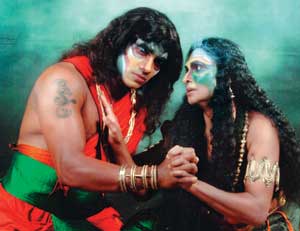
"S She bears him a son, named Sinhabahu (denotes prowess and attracts respect) who has a strength of a lion and a daughter, Sinhasivali.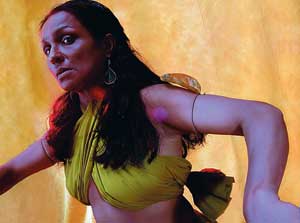




.JPG)